


We humans like many apes are social creatures who operate best in the company of others. We have family, usually pair up and we may have children too. Many will find it hard if they can’t achieve a union of some kind, others will choose to be solitary. Sometimes we are lucky enough to choose, some have the situation forced upon them. There is NO right answer, only the answer that suits the most important one, you. Many of us are grateful that the universe has provided us with what suits us best, albeit some will have a change of heart and choose alternatives either to belong elsewhere or to be more comfortable in their own skin.
Sue Gee spent her whole life looking for a sense of belonging, but it was only after she joined a women’s community that she finally discovered how to be happy in her own company. Another fine article by Paula Cocozza #
 @CocozzaPaula
Nine months ago, Sue Gee moved into the Gaia Temple, a women’s community in Melbourne – and learned to be by herself for the first time in her life. We are speaking via video call and she pans around the statuettes and icons. “I’m living with goddesses galore,” she says. There are fewer mortals – just Gee and two other residents.
Gee, who is 68, was “shattered” by a collision of life changes that coincided with the first stirrings of the pandemic. She retired from her job as a music therapist, went through the breakup of her long-term relationship, and moved to a new neighbourhood of Sydney.
Then lockdown happened. “Here I was, in this flat, in a place where I didn’t know anybody. All of the activities that I usually did, I was no longer allowed to do.” She was a member of two choirs, attended folk clubs and festivals, the gym, swimming pool … “All of that closed, gone, locked down, finished. I was totally by myself.”
“I was shouting at people, throwing things and screaming.
I went into a dark, dark place.”
Towards the end of her long-term relationship, Gee’s mental health “was so bad, I couldn’t control my behaviour. I was shouting at people, throwing things and screaming. I was so angry.” In lockdown, she became depressed. “I lost a lot of friends. I wasn’t very good company.” Her friends would say: “We’re all in the same boat. What’s so special about you?” “I went into a dark, dark place,” she says.
Gee has a younger brother, but he lived beyond easy reach, and her youngest brother had died when she was 14. Her parents had long since passed away. So when an operation for advanced osteoarthritis in her foot meant she was unable to bear her weight, she didn’t know who to ask for help. She approached acquaintances – “people I’d met at the gym or a lesbian dinner group or a buddy from art class” – and assembled a roster of helpers.
In a way, she had created her own mini-society, albeit a temporary one. She had previously looked for belonging in different belief systems. She was a “fanatical Pentecostal” in her 20s, when she was married to a man whom she met in church. Then later – after leaving her marriage and the church with a woman she met there – she became an avowed goddess follower in her 40s.

Photograph: Ellen Smith/The Guardian
She turned to the Pentecostal church after her little brother died at the age of four. The family moved from New Zealand to Sydney, “pretty cut up about it”, and her parents had to adjust to a new environment and new jobs. “So I was pretty much left to my own devices,” she says.
A sense of belonging is clearly important to Gee because since meeting her husband in her early 20s, she has been almost continuously “in serial monogamous relationships”. The loneliness of lockdown must have been horrific.
She had met the women who run the Gaia Temple at a goddess festival in Glastonbury in 2011, and did two years of goddess training with them. After lockdown, they asked her to be the temple’s artist-in-residence. Gee had planned to use her music therapy in aged care, but instead she took her autoharp, guitar and ukulele to Melbourne where she has run singing workshops and played at seasonal rituals.
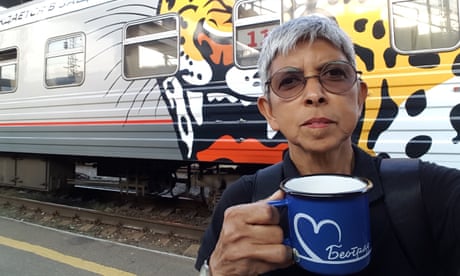
It seems counterintuitive that she should learn to be by herself in a community, but being among such a small number of residents while enjoying the comings and goings of a wider circle has pushed Gee towards extroversion. “It’s a skill I’ve had to learn,” she says. She has dinner in company most nights, enjoys the seasonal rituals every six weeks and works with visiting speakers and at weekend events.
Now she sits in restaurants alone, or goes solo on holiday and, she says: “I can bear to be by myself for the first time in my life.” It helps that she took up watercolour painting while recovering from osteoarthritis: a sketchbook is great company. “Sometimes people come along, have a look, a little chat.”
In the community, Gee has found a place for herself, and it’s a place of safety. “The women here have got my back.”
 It's the Time Of Your Life