




Background relating to changes in State Pension age for women in the UK
Before 1940, men and women’s State Pension age was 65. In 1940, women’s State Pension age was lowered to 60. In 1991, the Government announced its intention to equalise State Pension age. In December 1991 it published a consultation document, ‘Options for Equality in State Pension Age’, which described the policy rationale for the change, options for taking the policy forward and the financial effects of the change. The Government received over 4,000 responses to the consultation. The 1993 White Paper ‘Equality in State Pension Age’ set out the Government’s intention to equalise men and women’s State Pension age at 65. It highlights four drivers for the change:
- women were increasingly playing an equal role to men in the economy. The change would enhance the future pension entitlement of many women.
- people were living longer and healthier lives. A common pension age of 65 would strike a fair balance between generations.
- to help Britain maintain its international competitiveness.
- a State Pension age of 65 matched the trend in occupational pension schemes.
The change was to be phased in over a 10-year period between 2010 and 2020. The long lead-in period was to allow people sufficient time to plan ahead. The White Paper stated:
‘In developing its proposals for implementing the change the Government has paid particular attention to the need to give people enough time to plan ahead and to phase the change in gradually.’
and:
‘The change will not begin to be implemented until 2010. The lead-in period of over 16 years allows plenty of time for people to adjust their plans.’
The only reference to how the change would be communicated was in an appendix to the White Paper. Appendix 2 stated: ‘Most attendant publicity will be issued through the Government … Written notification of the change will be made by many employers’.
The ensuing Pensions Act 1995 provided that:
- men’s State Pension age would remain 65
- women born before 6 April 1950 would retain a State Pension age of 60
- women born after 5 April 1955 would have a State Pension age of 65
- women born between 6 April 1950 and 5 April 1955 would have a State Pension age of between 60 and 65, depending on their birthday. Schedule 4 of the Act set out the State Pension age for women born between these dates.
The 1995 Pensions Act made no provision for how the changes to women’s State Pension age would be communicated.
Further changes to State Pension age followed.
Under the Pensions Act 2007, the State Pension age for men and women was to increase to: 66 between 2024 and 2026, 67 by 2036, and 68 by 2046.
The Pensions Act 2011 sped up the timetable for raising men and women’s State Pension age. Under the 2011 Act, the increase in women’s State Pension age was accelerated so that it reached 65 by November 2018, instead of April 2020. The White Paper preceding the 2011 Act explained the drivers for the acceleration, including increasing life expectancy and the need for the State Pension to be affordable.
Originally, it was planned to increase State Pension age to 66 by April 2020. During the passage of the Bill, the timetable was adjusted so this would happen in October 2020 instead. The revised timetable capped the further increase consequent to the 2011 Act at 18 months (relative to the timetable set out in the 1995 Act), at a cost to the Exchequer of £1.1 billion. Women’s State Pension age would still reach 65 by November 2018, but the increase from 65 to 66 would happen more slowly. The impact assessment for the 2011 Act (published in November 2011, when the legislation came into effect), set out how the Government intended to communicate changes to State Pension age, including:
- ensuring that information about the changes was available on its website and in its leaflets and guides, and
- writing individually to 800,000 individuals born between 6 April 1953 and 5 April 1955 (those affected in the transitional period prior to State Pension age reaching 66, plus those who would have been affected in the transition to 65 under the original timetable).
The impact assessment also stated that the Government was considering how to communicate the changes to people born in subsequent years.
So that’s the dry government bit!

 Ruth Emery has written a fine article.
Waspi women: could they get £10,000 compensation under new bill?
According to a Work and Pensions Committee Report (2016), 1.1 million women were affected by equalisation of women’s State Pension age under the 1995 Act alone. A further 2.7 million women have had their State Pension age increased by both the 1995 and 2011 Acts.
For some women, the combined effect of the 1995 Act and 2011 Act meant an increase in State Pension age of up to six years
The 1995 Conservative UK Government’s State Pension Act included plans to increase women’s state pension age from 60 to 65 so that it was the same as men’s. WASPI agrees with equalisation, but does not agree with the unfair way the changes were implemented.
Because of the way the increases were brought in, women born in the 1950s (on or after 6th April 1950-5th April 1960) 3.8 million women have been hit particularly hard. We are angry that we have been treated unfairly and unequally just because of the day we were born. Significant changes to the age we receive our state pension have been imposed upon us with a lack of appropriate notification, with little or no notice and much faster than we were promised – some of us have been hit by more than one increase.
As a result, hundreds of thousands of us are suffering financial hardship, with not enough time to re-plan for our retirement. Women are telling us that they can’t believe their retirement age has increased by 4, 5 or 6 years and they didn’t even know about it!!
With no other source of income (until the 1990s many women weren’t allowed to join company pension schemes, many of us are carers or in poor health) securing work is proving impossible and zero contract hours or Job Seekers’ Allowance is the only alternative for many.
So how have 1950s women been treated unfairly and unequally?
1950s women have been singled out for unfair and unequal treatment because of the way the increases to our state pension age have been brought in.
WASPI has undertaken extensive research including FOI requests and have discovered that:
Recommendations to give fair notice were ignored
• The Turner Commission recommended 15 years notice, and Saga recommended 10 years. Yet many women report receiving little or no notice.
We weren’t appropriately or personally notified of the first changes in 1995
Some of us have been “hit” for a SECOND time – when in 2011 further increases to our state pension age were brought in faster than the Coalition had promised – again with little or no notice to re-plan for our retirement.
Women of a similar age have to wait disproportionately longer for their pension – a ONE year difference in birthday can make an almost THREE year difference to state pension age.
• Letters were sent out to women born on or after 6 April 1951 – 5 April 1953 14 years after the 1995 Pensions Act
• A large percentage of these women only received a letter advising them of significant increases to their State Pension Age within 1 year (i.e. when they were 59) of their expected State Pension Age of 60. Very many others received only 2, 3, 4 and 5 years notice.
• Women were given as little as one year’s notice of up to a 6 year increase to their State Pension Age, compared to men who received 6 years’ notice of a one year rise to their State Pension Age.
• Many women report receiving NO letter EVER
• Others say letters were sent to the wrong address despite notifying the DWP of the address change
WASPI have received many stories, including how:
• The job market isn’t ready to accept older women – many women are forced to accept zero hours, temporary and low paid contracts, which offer no financial security
• They are being forced to take jobs which are inappropriate to their state of health
• To qualify for limited Job Seekers’ Allowance, women are enduring humiliating tests/competitions by Seetec otherwise they face sanctions
• They are being forced to accept jobs which place them in a worsened financial situation
• Irreversible decisions have been made in the expectation of retiring at 60, eg, in times of austerity, accepting early redundancy/retirement
• Single, divorced or widowed women often have no other source of income
• Women have lost their independence – relying on husbands/partners to support them
• Women are unable to work as they care for elderly/ill parents or are in ill health themselves
• Retirement plans with husbands, partners, children and grandchildren have been shattered
• Women who have planned and saved for their retirement are living on dwindling limited savings until they reach their new State Pension Age when the only income they will have left will be their State Pension
BY RUTH EMERY
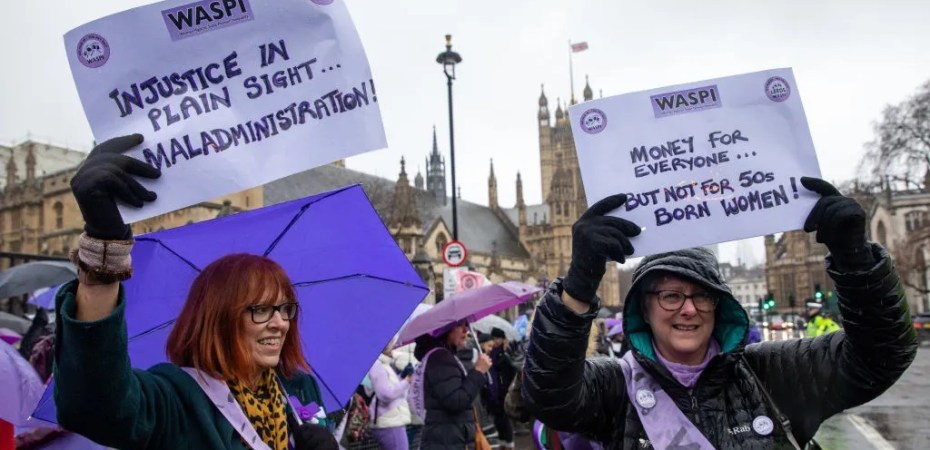
Women Against State Pension Age Inequality (Waspi) campaign group was set up to protest against the way changes to the state pension age were made.
From 2010 to 2018, the pension age for women gradually increased from 60 to 68, bringing it in line with men’s state pension age.
But the women affected by this – mainly those born in the 1950s – say the changes were implemented with little notice, leaving many in financial turmoil.
Waspi has repeatedly lobbied ministers, held protests, and even launched a judicial review over an ombudsman’s investigation into the way women were told about when they would receive their state pension. However, they have so far received no compensation.
The campaign group claims the “injustice” potentially affects 3.6 million women, and that since 2015, 269,329 Waspi women have died.
But could we see some progress this year? Earlier this month an MP put forward a bill calling for a compensation scheme with payouts of at least £10,000 for affected women. Will the bill get any traction in parliament? And when will the ombudsman publish a final report and make recommendations about redress? Could anything actually happen in a General Election year?
We outline the Waspi journey so far – and what could happen next.
THE WASPI CAMPAIGN
Until 2010, women could claim their state pension from age 60, and men from 65.
The government announced that women’s state pension age would be increased to match men’s, and would therefore raise their age from 60 to 65 in stages, between April 2010 and 2020.
It then sped up those changes, so that by December 2018 the age at which you could first claim your state pension was 65 for men and women. By October 2020 it was 66.
As well as the changes happening quickly, Waspi says the Department for Work and Pensions (DWP) failed to communicate them properly, so some women were completely in the dark.
Many women made big life plans based on when they thought they were getting their state pension – which then proved to be wrong – leaving them in financial hardship as they waited extra years to receive their pension.
Helen Morrissey, head of retirement analysis at the wealth manager Hargreaves Lansdown, comments: “This is a very difficult situation in that equalising state pension age for men and women is the right thing to do but it’s fair to say that many women were taken unaware of the change. The way government chose to communicate these changes has been criticised as it left many women with very little time to prepare for what became a gaping hole in their finances.”
While many MPs have supported the Waspi campaign, ministers have repeatedly ruled out any concessions, such as compensation to bridge the gap between the change in their state pension age or a one-off payment.
THE OMBUDSMAN’S INVESTIGATION
The Parliamentary and Health Service Ombudsman (PHSO), an independent body that looks into complaints made to government departments or the NHS, has been investigating the way the pension age changes were introduced.
In 2021, during the early stages of its investigation, it said the DWP had “failed to make a reasonable decision about targeting information to the women affected by these changes. That was maladministration.” It also concluded the DWP had “failed to act promptly” to write to the women.
The ombudsman was supposed to produce a draft report last year, but publication was delayed by a legal challenge by Waspi. The campaign group said: “The ombudsman’s office has consulted a number of individual complainants and Waspi about a draft of the final report on the investigation into DWP maladministration.
“The draft report is confidential, and we will respect that. What we can say at this stage is that Waspi’s legal team – Bindmans LLP and two expert barristers – have been working hard with us throughout December and January to prepare a detailed 31-page submission responding to the PHSO’s current thinking.”
It is hoped the ombudsman will give its verdict in March or April on whether the Waspi women should get compensation.
However, recommendations made by the ombudsman are not legally binding. It will be up to the DWP to decide if it will follow them; if it rejects them, the ombudsman could report to a parliamentary committee and ultimately there could be a parliamentary vote.
Steve Webb, partner at consultants LCP and a former pensions minister, tells MoneyWeek: “The ombudsman’s role is to judge whether people lost out because of maladministration. He has been clear from the start of this process that he respects the rights of parliament to set state pension ages and cannot over-rule that power.
“Any recommendation therefore is likely to focus on potentially creating a very narrowly defined redress scheme which might apply only to those who were unaware of the changes to state pension ages at a time when the government should have done more to notify them and who lost out because of decisions taken in ignorance.”
For example, a woman aged 58 might have handed in her notice at work thinking she could have her state pension in 18 months’ time, only to find out she had to wait another three to four years – but then she couldn’t get her old job back and never worked again. According to Webb, her loss could be said to be a direct consequence of the maladministration.
However, he adds: “Creating such a scheme would be incredibly challenging and it is likely the DWP would fight such a recommendation”.
If there was a parliamentary vote, the fact there’s an election this year could work in the Waspi women’s favour. MPs wouldn’t want to be seen to vote against the ombudsman’s recommendation and harm their chances at the ballot box.
Having said that, setting up a compensation scheme could be delayed because of the election; it could easily be dragged into the next parliament. So even if redress looks like it might become a reality, it’s likely to still be a distant reality.
Ros Altmann, a former pensions minister, says she hopes it “will not drag on much longer”. The baroness was repeatedly lobbied by Waspi during her stint as pensions minister in 2015 and 2016. Since leaving government she has spoken about the need to help women affected by the rapidly rising state pension age.
Altmann tells MoneyWeek: “I had always hoped we could at least get help to the women who suffered hardship, those who made plans based on inadequate or misleading information and those who are caring for others with little or no income.
“I fear this would not be acceptable to the majority of those affected, but if the ombudsman does recommend widespread compensation for everyone, then I would be delighted. But as I am one of those women I would not wish to accept anything myself as I knew about it.”
MP CALLS FOR £10,000 COMPENSATION
This month an MP put forward a bill calling for a compensation scheme for women born in the 1950s affected by the state pension age rise.
Alan Brown, a Scottish National Party politician, said the government should give compensation payouts of £10,000 or more.
Speaking in the House of Commons as part of a 10-minute motion, he said: “These women were given the bombshell that their state pension age was going to increase from 60 to 66 just as they were about to retire and it was too late to do any proper financial planning.”
Brown added: “It’s hard to believe that almost three years after the maladministration assessment, a solution is still to be recommended by the ombudsman.
“It’s a scandal in itself that the Waspi women had to go to court to confirm the flaws in the second ombudsman report. This process should have been closed out a long time ago.”
He said that with regards to compensation, a minimum Level 5 banding of the Parliamentary and Health Service Ombudsman remedy scales should be applied but that a Level 6 band with payouts of £10,000 or more would be “most appropriate”.
Brown suggested that changing capital gains tax rates and non-dom tax status could be a way of funding the compensation scheme.
However, critics say a blanket payment scheme would fail to distinguish between people who knew their state pension age was going up and others who hadn’t been properly contacted by the DWP and had suffered as a result. It would also be incredibly expensive, running into billions of pounds.
Morrissey notes: “I also think the £10,000 figure would be seen as insufficient by many of the affected women who believe their loss to be much more.”
She adds that the government has always resisted the idea of paying compensation “and I would expect them to continue to do so. The workings of any compensation scheme could also be tricky – who would be eligible? Would it be all women in that cohort in which case the cost would be huge, or only those who had experienced the most financial hardship?”
The DWP says: “The government decided over 25 years ago that it was going to make the state pension age the same for men and women. Both the High Court and Court of Appeal have supported the actions of the DWP, under successive governments dating back to 1995, and the Supreme Court refused the claimants permission to appeal.”
 It's the Time Of Your Life